
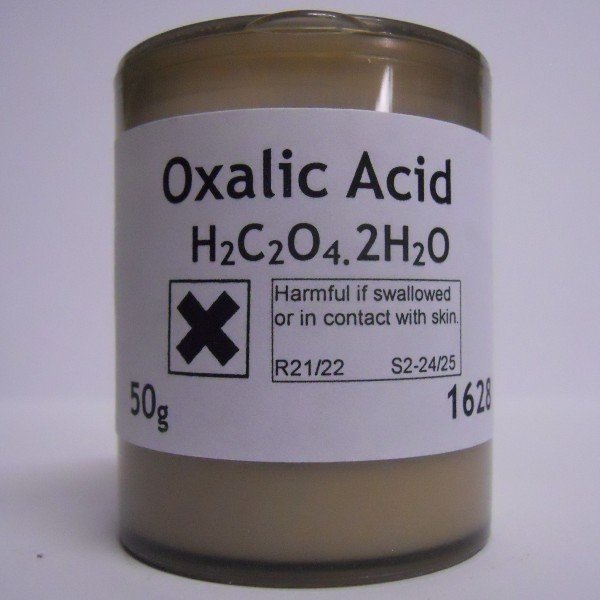

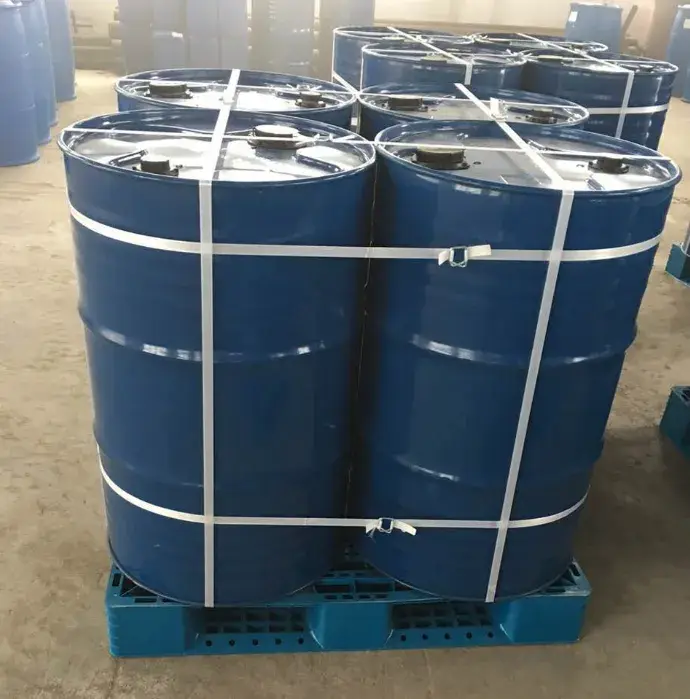
Oxalic acid is an organic substance with the chemical formula H₂C₂O₄·2H₂O. It is a metabolite of organisms, a medium-strong acid, widely distributed in plants, animals and fungi, and plays different functions in different organisms. Studies have found that more than 100 plants are rich in oxalic acid, especially spinach, amaranth, beet, purslane, taro, sweet potato and rhubarb. Since oxalic acid can reduce the bioavailability of mineral elements, it is easy to form calcium oxalate with calcium ions in the human body, causing kidney stones, so oxalic acid is often considered to be an antagonist of mineral element absorption and utilization. Its anhydride is carbon trioxide.
Chemical Properties
| Property | Value |
| Melting point | 189.5 °C (dec.)(lit.) |
| Boiling point | 365.1°C (estimate) |
| Density | 0.99 g/mL at 25 °C |
| Vapor density | 4.4 (vs air) |
| Vapor pressure | <0.01 mm Hg ( 20 °C) |
| Refractive index | 1.4261 (estimate) |
| Fp | 101-157°C |
| Storage temp. | Store below +30°C. |
| Solubility | Water: soluble108g/L at 25°C |
| Form | Liquid |
| Pka | 1.23(at 25℃) |
| Color | White |
| PH Range | 6 – 8 at 25 °C |
| PH | 3(1 mM solution);2.09(10 mM solution);1.31(100 mM solution); |
| Odor | Odorless |
| Water Solubility | 90 g/L (20 ºC) |
| Sublimation | 101-157 ºC |
| Merck | 14,6911 |
| BRN | 385686 |
| Henry’s Law Constant | 1.43 at pH 4 (quoted, Gaffney et al., 1987) |
| Exposure limits | NIOSH REL: TWA 1, STEL 2, IDLH 500; OSHA PEL: TWA 1; ACGIH TLV: TWA 1, STEL 2 (adopted). |
| Stability: | Stable, but moisture sensitive. Incompatible with metals. |
| InChIKey | MUBZPKHOEPUJKR-UHFFFAOYSA-N |
| LogP | -1.7 at 23℃ |
| CAS DataBase Reference | 144-62-7(CAS DataBase Reference) |
| NIST Chemistry Reference | Oxalic acid(144-62-7) |
| EPA Substance Registry System | Oxalic acid (144-62-7) |
Safety Information
| Property | Value |
| Hazard Codes | Xn |
| Risk Statements | 21/22-63-34-41 |
| Safety Statements | 24/25-23-36/37/39-27-26-39-37-36-36/37 |
| RIDADR | UN 3261 8/PG 3 |
| WGK Germany | 1 |
| RTECS | RO2450000 |
| TSCA | Yes |
| HazardClass | 8 |
| PackingGroup | III |
| HS Code | 29171110 |
| Hazardous Substances Data | 144-62-7(Hazardous Substances Data) |
| Toxicity | LD50 orally in Rabbit: 375 mg/kg |
| IDLA | 500 mg/m3 |
Product Usage
Oxalic acid is a highly versatile organic compound widely utilized across various industrial sectors. Its primary application lies in surface treatment and cleaning, where it acts as a potent rust remover for metal parts and a bleaching agent for wood and textiles. In the chemical industry, it serves as a crucial reagent for synthesizing pharmaceutical intermediates and purifying rare earth elements. Additionally, it is employed in commercial laundry to remove stubborn mineral stains and in wastewater treatment to neutralize alkaline solutions.
The top ten uses of Oxalic Acid Solution:
Rust Removal: Oxalic Acid Solution is effective in removing rust from various surfaces, including metals and fabrics.
Bleaching Agent: It can act as a bleaching agent for wood and is used to lighten or remove stains from wood.
Cleaning Agent: It’s used in cleaning solutions to remove tough stains and buildup from surfaces like countertops, tiles, and sinks.
Leather Tanning: In the leather industry, oxalic acid is used in the tanning process.
Dyeing Process: It’s used as a mordant in dyeing processes, helping to fix dyes to fabrics.
Removing Ink Stains: Oxalic Acid Solution is effective in removing ink stains from various materials.
Stone Cleaning: It can clean certain types of stone surfaces, removing stains and restoring their natural appearance.
Water Treatment: In small concentrations, it can be used to purify water by removing certain minerals and contaminants.
Pharmaceuticals: Used in small amounts in the pharmaceutical industry for various manufacturing processes.
Laboratory Use: It’s used in laboratories as a reagent and for cleaning lab equipment.
Always remember, when handling oxalic acid, it’s important to use appropriate safety measures, including gloves and eye protection, as it can be harmful if inhaled, ingested, or if it comes into contact with skin.


Reviews
There are no reviews yet.